
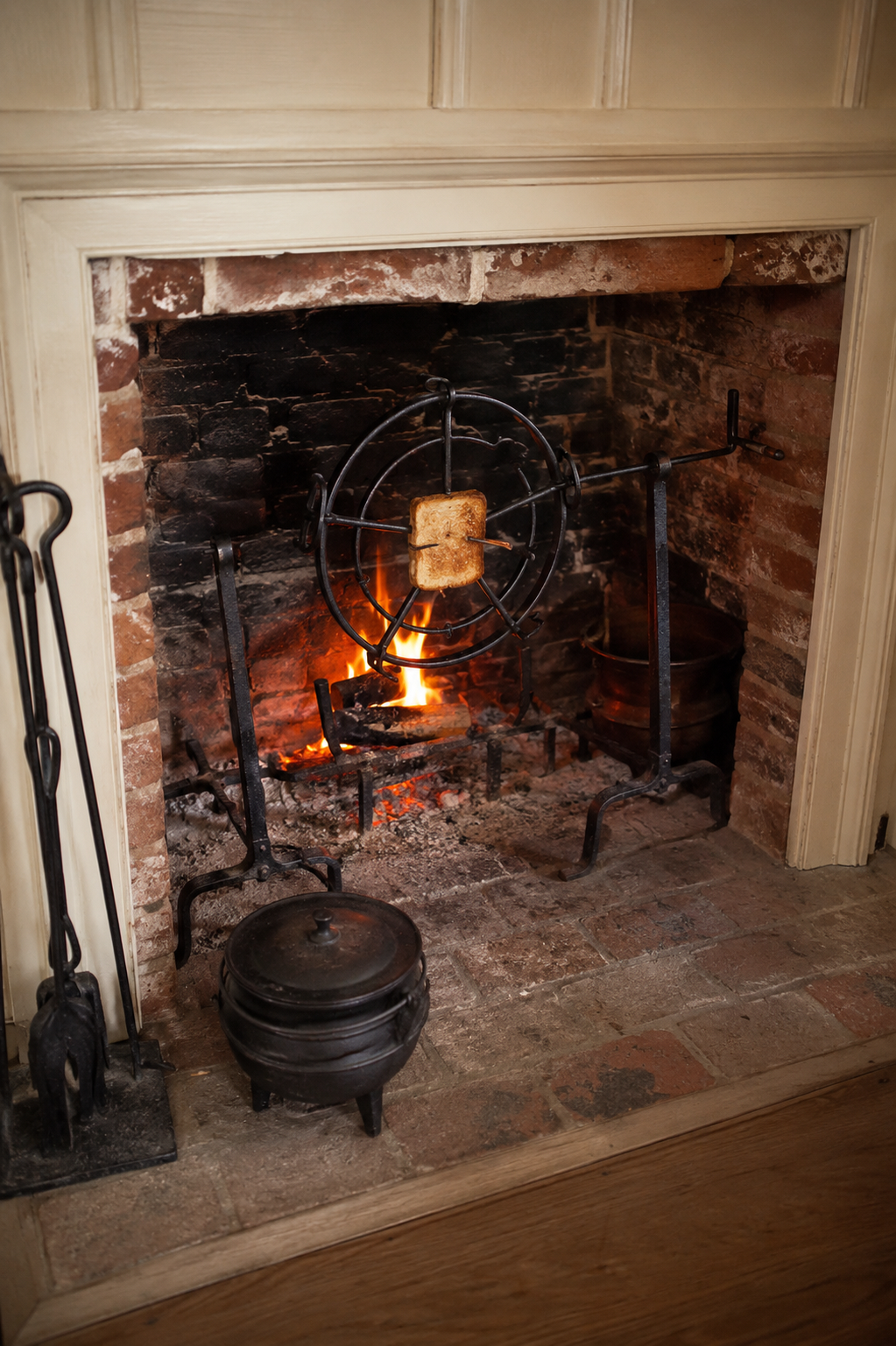

In the 18th century, there was a pervasive belief that untoasted fresh bread caused digestive issues, making toasting an important part of daily life.
Revolutionary War-era fireplace implements consisted of locally hand-forged wrought iron toasting forks and small rotary racks or baskets with long handles. Other racks were mounted on a pivot with a circular rotating holder containing the slice of bread. All of these tools allowed cooks to brown both sides of the bread without burning their hands. Some of these devices included feet or a resting frame to prop them up in front of the fire.
I recently watched a short documentary about the time of the American Revolution and was butterly gobsmacked to learn that these utensils are where we got the word “toast” (and “toaster”) because people allegedly nudged the appliance with a TOE to turn the bread away from the fire to prevent it from getting too well done.
I could not wait to share this newfound information with you. I always do my research when writing stories about real people, places and things; I was more shocked than my earlier gobsmackedness when I found out that this (presented as) fact is cuckoo for cocoa puffs! In FACT a myth, early metal toasters were never turned with toes, bare or booted. In FACT, the English noun “toaster” was recorded in text from the 1580s!
A piece of history had been giveth, it should not have been taketh away. Shame on that documentary maker! I think an email to them is in order.
But first, I have a sudden craving for a piece of toast. For the historical record, no toes will be involved.
#SisterRain #ALittleSightALotOfHeart #LegallyBlindWriter #USHistory #AmericanHistory #USA #UnitedStates #America #AmericanRevolution #America250
